Hello Bethy: Integrating a Brush Script Typeface into Creative and Professional Workflows
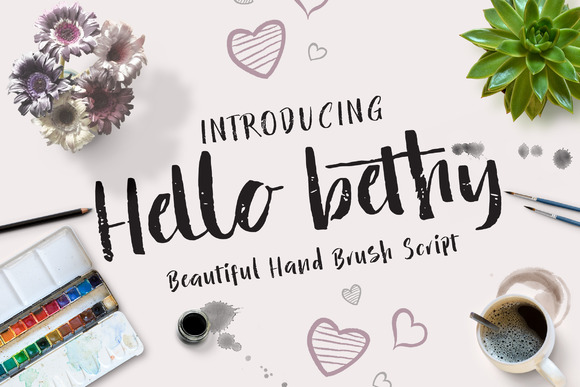
The selection of a typeface is often a pivotal decision in the creative process. It sets a tone, communicates personality, and forms the visual foundation for a project’s message. For professionals and creators seeking a font that combines elegance with versatility, Hello Bethy emerges as a distinctive brush script typeface designed for seamless integration into diverse workflows. Unlike generic fonts, Hello Bethy offers a specific aesthetic—a beautiful, hand-crafted script style—that can elevate projects ranging from digital marketing assets to physical print materials.
The Role of a Specialty Typeface in Project Planning
Before a designer opens a software application or a marketer drafts a campaign brief, considering the final visual assets is a crucial planning step. Introducing Hello Bethy at this early stage allows you to define a cohesive stylistic direction. Its character lends itself to projects requiring warmth, authenticity, or a personal touch. For instance, when planning a brand identity for a boutique business, a series of wedding invitations, or a greeting card line, specifying Hello Bethy as the primary or accent font in your style guide ensures consistency from the outset. This pre-definition prevents later indecision and maintains aesthetic alignment across all deliverables.
Hello Bethy interacts directly with other foundational assets. Its design should be evaluated alongside your color palette, logo marks, and imagery mood boards. Because it is a script font, it often pairs best with simpler, complementary sans-serif or serif typefaces for body text, creating a balanced and readable hierarchy. Deciding on these pairings during the planning phase streamlines the later execution.
Execution and Application Across Mediums
Once a project moves into the active creation phase, Hello Bethy’s technical design facilitates smooth implementation. The font comes with a complete set of standard characters, punctuation, and international glyphs, which is essential for professional use. This completeness means you can deploy it for client work without worrying about missing symbols or awkward character substitutions, ensuring quality control in final outputs.
The true utility for hands-on creators lies in its OpenType features. Features such as Ligatures and Alternates are not mere embellishments; they are practical tools for refining typography. Ligatures automatically combine certain character pairs into a single, more graceful glyph, improving the visual flow of the script. Alternates offer different versions of specific letters, allowing you to fine-tune a word’s appearance to avoid awkward overlaps or to achieve a specific rhythm. Accessing these features within applications like Adobe Illustrator, InDesign, or Photoshop—through the Opentype panel—is a routine part of the typesetting process for skilled designers.
Common Use Cases and Workflow Integration
The applications for Hello Bethy are broad, but integrating it effectively depends on understanding the medium.
For digital graphics such as social media posters, website headings, or email campaign banners, using Hello Bethy as a focal point draws attention. In these workflows, you export the final asset, but the preparation involves ensuring the font renders correctly at various sizes and on different backgrounds. Testing a few key headings at small and large scales confirms legibility.
In print design for invitations, labels, or book covers, the process involves more material considerations. Here, you must confirm that your printing service supports the embedded font or outline the text to avoid substitution issues. The high-quality curves of Hello Bethy translate well to physical printing, making it a reliable choice for luxury or personal print items.
For product design, like t-shirts or mugs, the font often becomes a central artwork element. In this workflow, you might manipulate the text into a specific shape or combine it with illustrations. The PUA Unicode coded fonts included in Hello Bethy ensure compatibility with various cutting and engraving software that might require special character encoding.
Practical Implementation Tips for Everyday Use
Adopting a new typeface into your regular toolkit requires a degree of organization. For freelancers and small business owners who manage multiple projects, keeping a well-curated font library is part of maintaining efficiency. Installing Hello Bethy and familiarizing yourself with its OpenType features through a simple test document saves time during future client work. Create a personal reference sheet showing its alternates and ligatures to quickly recall its capabilities.
Consistency across projects is a marker of professional output. If Hello Bethy becomes part of your brand’s identity—for your own studio logo, for instance—use it consistently on your website, business cards, and proposal documents. This repeated application reinforces brand recognition.
For educators, bloggers, or productivity-minded users creating personal projects, the font selection process is simpler but still impactful. Using Hello Bethy for the title of a published PDF guide, the header of a blog post graphic, or a personalized holiday card adds a layer of polished creativity to otherwise routine tasks. The key is to reserve it for accent text where its decorative nature enhances without overpowering.
Long-Term Utility and Creative Evolution
A quality typeface is a long-term asset. Hello Bethy’s design, with its extensive glyph set and OpenType programming, is built for enduring use. As your skills or business needs evolve, the font can adapt. Learning to leverage its stylistic sets more deeply over time allows for more sophisticated typographic results. Furthermore, its support for international characters means it can be employed for projects targeting global audiences, scaling its usefulness.
In collaborative workflows, where files are shared between designers, developers, or printers, the inclusion of a well-supported font like Hello Bethy minimizes technical friction. Specifying the font in shared style guides and providing the necessary files to licensed collaborators ensures everyone is working from the same visual baseline, which is essential for efficient team projects.
Ultimately, integrating Hello Bethy is about recognizing where a brush script’s humanistic quality can serve a functional purpose. It fits into the workflow not as a random decorative choice, but as a deliberate tool selected during planning, applied with precision during execution, and maintained for consistency across a body of work. Its value is realized when it moves from being simply installed on a computer to being an active, considered component in the creation of meaningful visual communications.